



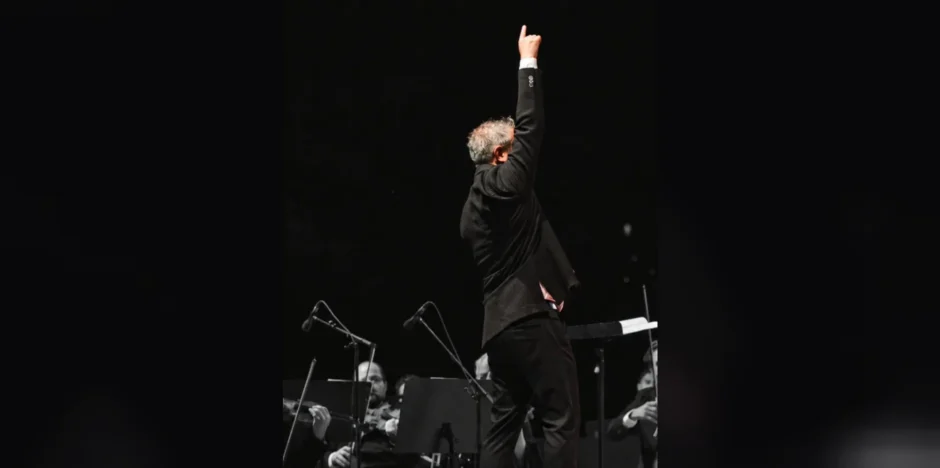
Vladimir Dimovski talks about his musical work, the orchestra and the preparation of concert programmes. The interview, published by the Bitola Cultural Information Centre, presents the artistic perspective behind the performances.
Through the conversation we learn about the work behind the programmes, and about Dimovski’s view of the artistic process beyond the performance itself.
The man behind the baton
The audience usually sees Vladimir Dimovski on stage, in front of the orchestra, at the moment when the music is ready and shared with listeners. But the road to that evening is long. It includes choosing the repertoire, working on arrangements, talking with soloists and guests, countless rehearsals and decisions the audience never sees, yet without which no concert would be possible.
Beyond the concerts, conversations like this allow us to get to know the person leading the artistic process. They connect the public presence on stage with reflections on music and the experience of working with an ensemble.
Part of our story
Vladimir Dimovski is one of the people behind the revival of the orchestra in 2013 and behind many of the programmes that marked the past decade. That is why his view of music and of working with musicians is an important part of understanding how the orchestra became what it is today.
From the audience at the Officers’ Home to the podium
The interview took place right after a concert in the hall of the Officers’ Home, a place with special meaning for Dimovski. As a young music student he attended an Interfest concert there that inspired him to dream of an orchestra giving regular concerts. He discovered his first love of chamber music playing in the Bitola Chamber Orchestra under Zoran Manevski some twenty years ago. He began his musical education on the violin, switched to viola in secondary school and graduated in viola from the Faculty of Music Arts in Skopje.
He describes reviving the orchestra, together with Nikola Trajanovski, as a great challenge and an honour. More than 200 concerts have been organised in recent years, and although the orchestra also performs popular music, its core commitment remains classical music, which it wants to bring closer to audiences in Bitola, Skopje and beyond.
How a programme comes about
The idea for the MTV project came from the wish to revisit the music of the eighties, following the example of great world orchestras that often bring classical and popular music together. He chooses songs by three criteria: whether they have orchestral potential, whether they have musical depth and whether there is a suitable singer. There are no formal auditions: collaborations come from earlier performances, recommendations or direct contact, and he looks at vocal quality, stage presence and attitude to music.
For a concert of 12 to 18 songs, most of the time goes into writing the arrangements, because popular songs rarely come with orchestral scores. He writes about 98 percent of the arrangements himself. The orchestra also regularly performs works by Macedonian composers, and last year a whole concert was devoted to Macedonian composers, conducted by Borjan Canev.
Away from the stage
He loves almost all music except turbo-folk and has followed techno since his youth. He sees conducting as a responsibility, not a boost to the ego. The greatest reward, he says, is the moment after the last note when the applause begins, and when people come up after the concert to thank the musicians. He likes to spend his free time with his daughter.
He also named the partners without whom the concerts would not be possible: general sponsor IWConnect, the Bitola companies Sinpeks, Hemometal and BV Inženering, and the Municipality of Bitola and the Ministry of Culture. In the first years after the revival, he says, organising concerts without support was very difficult.
We include the interview as part of our story about the people behind the programmes, alongside concert announcements and records of past performances. Thank you to the Bitola Cultural Information Centre for the conversation.